
Emergency Works: Coordinated Environmental Delivery Across a Multi-Infrastructure Corridor
Cornice supported CN Railway’s emergency response team in the planning, regulatory coordination, and environmental oversight of emergency works on the railway near Chilliwack, BC.
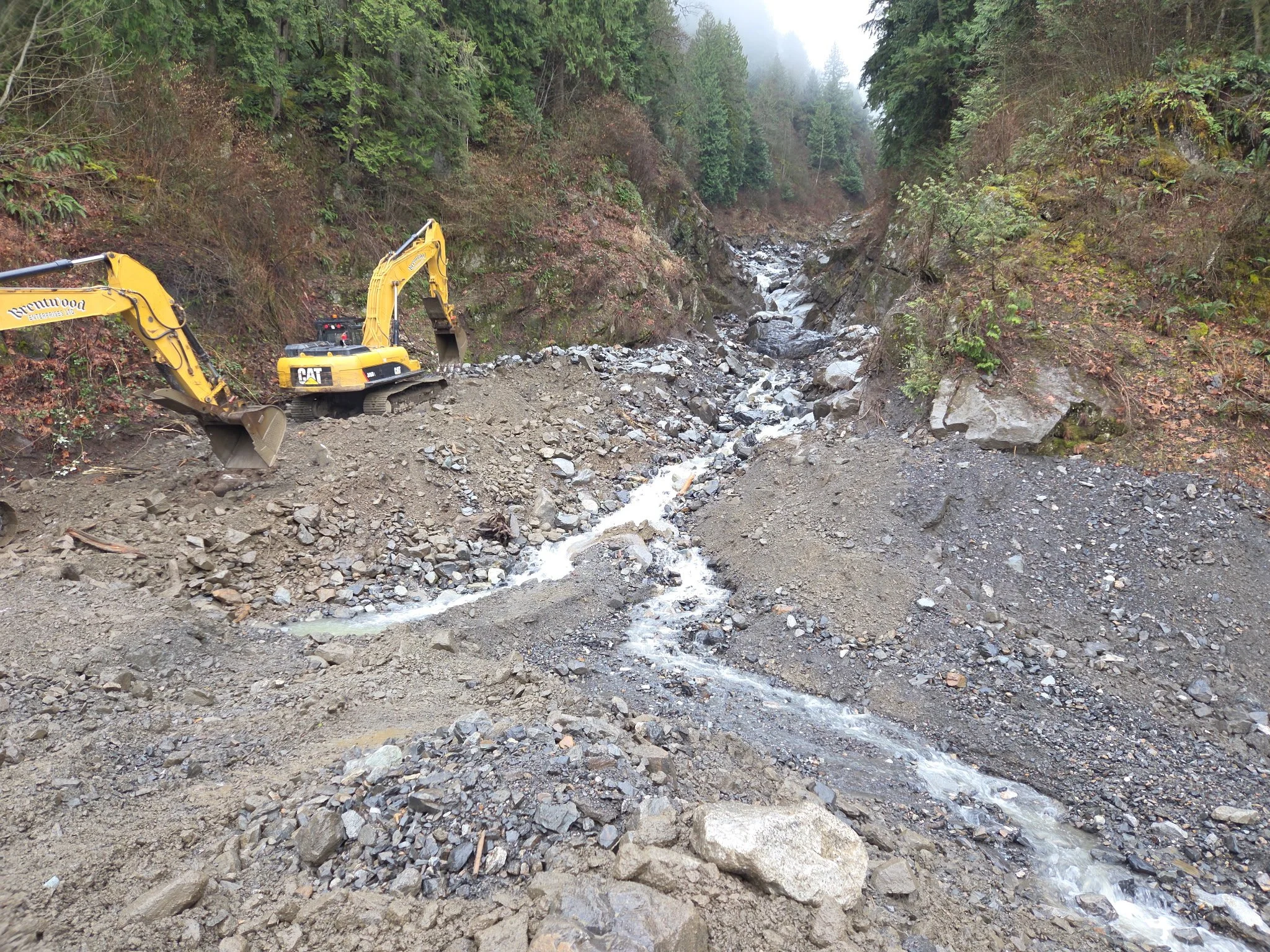
The project addressed a sudden stream avulsion that redirected flows from a 200+ ha watershed into a smaller, lower capacity historical drainage system, resulting in flooding and partial rail grade failure. The event introduced immediate and ongoing risk to a shared infrastructure corridor including railway, Highway 1, and the Trans Mountain pipeline, as well as downstream First Nations lands.
Project Control Support in Practice
This project reflects Cornice’s role in complex, time-sensitive environments:
Aligning regulatory, technical, and construction requirements
Supporting client decision-making under uncertainty
Integrating multiple stakeholders and disciplines
Maintaining environmental compliance while enabling delivery
Cornice operated as a coordinating layer between field execution, regulatory frameworks, and project leadership—ensuring clarity, structure, and accountability.
The Challenge
The project required rapid coordination under emergency conditions, with several concurrent constraints:
Active hydrological instability due to ongoing avulsion and sediment transport
Risk exposure across multiple infrastructure systems (rail, highway, pipeline)
Requirement for emergency regulatory approvals (provincial and federal)
Engagement and coordination with First Nations and multiple agencies
Limited baseline data and evolving field conditions
Need to align design, approvals, and construction within a compressed timeline
The work needed to proceed prior to the next high-flow event while maintaining environmental compliance and minimizing downstream impacts.
The Approach
Regulatory Coordination
Supported securing emergency authorization under:
Section 93 Order (BC Water Sustainability Act)
Fisheries and Oceans Canada Section 35(2)(b) Emergency Authorization review and Letter of Advice
Coordinated with provincial regulators to align scope, timing, and mitigation measures
Supported communication pathways with Ministry of Transportation, Trans Mountain, and First Nations representatives
Environmental Planning and Technical Input
Design intent focused on restoring flow to the original channel and reducing long-term avulsion risk.
Prepared the Environmental Protection Plan and subsequent official correspondence to reflect evolving site conditions
Assessed fish and fish habitat potential using desktop analysis and field verification
Defined site mitigation measures for:
Sediment and erosion control
Flow diversion and staged channel reinstatement
Fish monitoring and salvage
Construction Integration and Field Support
Supported execution strategy to prioritize construction in the dry where feasible
Advised on staged diversion of flows back into the original channel to manage turbidity and channel stability
Integrated environmental monitoring with active construction activities, including coordination with Assuage Environmental
Key construction elements included:
~870 m continuous offset retaining berm
Downstream berm to protect adjacent lands
Catchment basin and opposing spurs to manage sediment deposition and reduce debris flow risk
Adaptive Management
Adjusted mitigation measures in response to observed conditions, including turbidity and channel response during flow reintroduction
Supported decision-making during temporary work stoppage to allow for additional engineering and stakeholder review
Maintained alignment between field conditions, regulatory expectations, and client objectives
Outcome
Flow successfully restored to original channel alignment
Infrastructure risk reduced across rail, highway, and pipeline systems
Regulatory requirements met under emergency authorization pathways
No major environmental incidents during construction
Fish presence assessed and managed; no significant impacts identified
Construction progressed efficiently under emergency conditions, with environmental mitigation measures implemented throughout.